Gaining People’s Attention from the Start

Share:

People often come into Bible classes quite distracted. Some may not even want to be there. We need to get their attention from the start so they’re able focus on God’s Word. How do we do that?
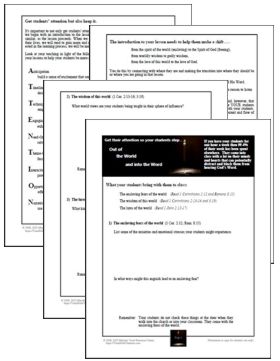
Gain Attention from the Start to Get People Out of the World and into the Word
Check out the four-page Out of the World and into the Word Worksheet. This reproducible teacher training resource begins by looking at some of the distractions of the world students bring with them. It provides ideas for how teachers can use the lesson introduction to gain students’ attention. The worksheet ends with an acrostic for how to keep that attention.

Three Tips for Gaining People’s Attention from the Start

We’ll narrow “how to” down to three tips.

1) Grab people’s attention through creativity.

We need a means of capturing their attention for what’s to come that gets them curious, fascinated, or intrigued. Titus 2:10 points to making “the teaching about God our Savior attractive” “in every way”. At minimum Bible teachers should guard against beginning lessons the same way each time. Varying our approach will pull people in because they don’t know what to expect.

2) Give people a reason to engage and learn through relevance.

The Apostle Paul practiced this means. He said, “I have become all things to all people so that by all possible means I might save some” (1 Cor. 9:22). By connecting with where students are, we can then take them to where they should be.

3) Build a foundation through personal connection.

Gaining people’s attention through creativity and relevance may initially pull them in but personal connection will help keep their attention. When people believe we care, we earn their attention. Ultimately we want people to get their attention on God, but it often begins by finding a connection with us. Look at the Apostle Paul’s example. He said, “Just as a nursing mother cares for her children, so we cared for you. Because we loved you so much, we were delighted to share with you not only the gospel of God but our lives as well.” (1 Thess. 2:8)

For More, Go To: Getting and Keeping Attention Starting with the Lesson Introduction Teacher Training Resources


Share:

Steps to Guide Bible Lesson Preparation

Share:

Bible Lesson Preparation That Correctly Handles the Word
If we care about what God wants, we will grasp the importance of lesson preparation. He tells us, “Do your best to present yourself to God as one approved, a worker who does not need to be ashamed and who correctly handles the word of truth.” (2 Tim. 2:15)

Effective preparation will surely require a process that keeps us accountable and trusting in God. We can’t haphazardly throw a lesson together and be reasonably assured we’re in sync with God’s intent. So, what steps should guide Bible lesson preparation?

An Acrostic with Steps to Guide Bible Lesson Preparation

Using an acrostic can help us work through steps needed in preparing a Bible lesson. It can be used as an easy-to-use checklist each time we prepare. Though this could be a suggested order for preparation, there may be some overlap of the steps as well as a possible need to retrace steps.

P – Pray

Seek God’s help from the start and throughout the preparation process.

R – Read

Grasp the big picture of the Scripture being used in the lesson.

E – Exposit

Break down what Scripture says, perhaps in the form of an outline. Ask pertinent questions about what you’re reading.

P – Pause

Meditate and reflect on it what you’ve studied.

A – Assess

Determine the aim that fits Scripture and your students and what content to include.

R – Re-read

Read Scripture again and make sure your assessment is headed in the right direction.

A – Arrange

Pull it all together with activities (methods) to present Bible content and an appropriate application and introduction.

T – Test

Go through the lesson to make sure it flows and that activities will work in your setting.

I – Include

Determine materials needed for visuals and methods and gather materials.

O – Outline

Make an outline of the flow and content of the lesson. Use it as notes when presenting the lesson rather than read verbatim from a lesson book. Preparing this outline also serves as a review.

N – Nurture

Prepare yourself for teaching the lesson through prayer, review, and personal application. Also ask God to nurture the hearts of your students in preparation for the lesson.

Other Tools to Help with Preparing a Bible Lesson:

Please note that the following resources do not include the above acrostic.


Share:

Application a Vital Part of Bible Lessons?

Share:

As Bible teachers we need to remember that ultimately we’re not there to merely teach content. We need to also get to the application of that content to life.

Points to Help Us Make Application a Vital Part of Bible Lessons

Application is a vital part of Bible lessons as seen in Colossians 1:9-10. Take note of the following from that passage:
From Knowledge to Application
1) Notice the role of prayer. — Paul said they “have not stopped praying” for the Colossians.

Paul obviously prayed like he truly believed God was the One who brought growth and change. Teachers who teach for application must envelop the teaching-learning process in prayer. — Teacher Training Resource: Praying Like You Truly Believe HE is the Source of All You Need Worksheet

2) Notice the starting point. — “knowledge of His will” coupled with “spiritual wisdom and understanding”

Paul wanted God to not only help them know the Word but also see the implications of it for life. People aren’t going to get to the point of application without an understanding of how the Scripture relates to their lives.

3) Notice the objective. — “live a life worthy of the Lord and may please him in every way”

Paul wanted the Colossians to live to the glory of God, not merely know about Him. That meant doing something with what they knew … application of truth.

4) Notice the progression.

Paul realized people wouldn’t just move from the starting point of “knowledge of God’s will” to the end result of “bearing fruit in every good work, growing in the knowledge of God”. There would be steps to progress through. (Click links for more on each of these steps.)

5) Notice the end result — “bearing fruit in every good work, growing in the knowledge of God.”

Paul believed that if these believers knew and understood God’s will and applied it to their lives, two things would happen:

  • Their lives would make a difference for eternity.
  • They would get to know God even better and the cycle would start all over.

Surely this is the end result we want to see in our students’ lives as well. To get there, pray for those you teach. Then start with truth from God’s Word, making sure they understand it, not merely cognitively but also practically. Keep the ultimate objective always before them.

Helpful Teacher Training Resource:

Including an emphasis on application isn’t just a good idea, it is God’s idea. Check out the Application: It’s God’s Idea, Not Merely a Good Idea Worksheet to better understand God’s intent for Bible teaching.

Share:

Another FAQ about Lesson Preparation

Share:

Bible Lesson Preparation and the Holy SpiritWe’ve already looked at a reason Bible teachers might give for not spending much time or effort on preparing their lessons:

Another reason one might ask about pertains to the role of the Holy Spirit.

Another Question Pertaining to Bible Lesson Preparation and the Holy Spirit

Why spend time preparing when we have the Holy Spirit? Isn’t the Spirit enough?

While it certainly is true that we need the Spirit to work through us, it is also true that God tells us to “do your best to present yourself to God as one approved, a worker who does not need to be ashamed and who correctly handles the word of truth” (2 Tim. 2:15). The Greek word translated as “do your best”, sometimes translated as “study”, means “to hasten to do a thing, to exert oneself, endeavour, give diligence” (Vines Expository Dictionary). That means we are not to just sit back. As God’s Word sinks into our hearts, the Spirit will work both in and through us. Though God, through the working of the Spirit, is the One who brings the growth and change, He views us as “co-workers in God’s service” whom He uses to plant and water the Seed of His Word (1 Cor. 3:6-9).

You’ll find a few more thoughts about this question in the Bible Teacher’s Handbook of Frequently Asked Questions. In addition, you’ll find responses to a few other questions about lesson preparation.

If just teaching children, why would we need to invest much time into preparing lessons?

Why study Scripture when preparing a lesson if the curriculum does it for us?

How do we prepare a lesson from scratch, without a curriculum guide?

The handbook covers 49 different issues related to Bible teaching with a total of 153 questions.

More Helpful Resources:

Share: