Options for Getting Beyond Lecture

Share:

Get Beyond Pure Lecture and Teach in Ways that Align with God's Intent Found in Colossians 1:9-10
Lecture may be good to use with adults but if we want to teach for changed lives and potentially reach all the students, we must get beyond solely lecturing. Remember that while God wants “to fill you with the knowledge of his will”, He also wants us to “live a life worthy of the Lord and please him in every way: bearing fruit in every good work, growing in the knowledge of God” (Col. 1:9-10). We need to teach in ways that help people reach His intent.

Reason Bible Teachers May Feel They Have No Choice But Lecturing

To determine what can be done in lieu of lecture, we must look at reasons teachers may feel they can only lecture. They might say something similar to the following:

1) “I would never get through the lesson if I didn’t lecture.”

This reason deals with the content, specifically the amount of content.

2) “My class is too big to use other methods.”

This reason pertains to class size and the challenges of teaching a large group.

3) “I don’t know other methods that would work with adults.”

This reason relates to the skills of the teacher, particularly in regard to methodology.

Options Beyond Lecture

Think about how you can implement the following options if you find yourself saying any of the above.

1) If you feel you couldn’t get through the lesson without lecturing …

Consider the possibility that you may be trying to teach too much in one setting. The greater the amount of content, the less likely you’ll be to employ other methods. How can you trim the content down without losing substance? Or, can the lesson be divided into two sessions providing time for discussion or other methods? Can you use out-of-class means to communicate some of the content so students come to class prepared to do something with the content?

2) If your class seems too big to use other methods ….

Though it would seem that bigger groups lessen opportunity for each individual to meaningfully participate, there are ways to engage everyone. It takes thinking outside of the box to get a large group of students more actively involved. Perhaps you could break the class into smaller groups or neighbor nudge to discuss a question. You could have students write down their response and then ask only a few to share what they wrote. Maybe you could have them physically respond to questions by a raise of hands, standing, holding up colored or numbered cards you’ve provided to respond to yes/no questions, etc. When you do lecture, accompany it with visuals, handouts, and good illustrations.

3) If you don’t know of other methods that work with adults …

Determine if you’re just stuck in a rut. Perhaps you do know other methods but have gotten comfortable with lecturing. Maybe you’re doing what takes less prep time. If so, remember why it’s important to get beyond solely lecture. If you truly want to teach for changed lives and potentially reach all of your students, then start by gradually adding some different methods into your teaching.

It could be that you aren’t acquainted with all the possibilities and need some training on teaching methods. Check out the Sharpening Your Bible Teaching Methods resource.

If you lecture because you struggle with creativity, check out these resources:

We do usually have other options besides pure lecture. We may have to make some adjustments but in the end, it will be worth it.

Share:

Why We Need to Get Beyond Only Lecture in Adult Classes

Share:

Some teachers of adult Bible classes primarily lecture. While lectures have a place in teaching adults, we do need to think of the potential for real learning. That should inspire us to get beyond solely lecturing. Consider the following points.

Get Beyond Lecture in Adult Classes to Increase the Potential for Changed Lives

Perhaps some teachers primarily lecture in adult Bible classes because they have a lot of content for students to absorb. After all, we may reason, they have a longer attention span than children and youth. While that reasoning may hold some truth, more is not always more. Sometimes less is more. It all depends on our objective. Are we teaching for changed lives or mere head knowledge? Do we want people to get to know the Lord better, not just about Him, in ways that make a difference in their lives?

To take people to higher levels of learning, that lead to applying truth to life, we must get beyond lecture. People need opportunity to work through the implications and application of truth, to gain a better understanding of how truth relates to everyday living.

Change Described in Colossians 1:9-10 Requires Getting Beyond Lecture in Adult ClassesNotice the flow in Colossians 1:9-10 which begins with knowledge but goes to understanding and application which results in bearing fruit and getting to know God better.

We continually ask God to fill you with the knowledge of his will through all the wisdom and understanding that the Spirit gives, so that you may live a life worthy of the Lord and please him in every way: bearing fruit in every good work, growing in the knowledge of God …

Get Beyond Lecture to Increase the Potential of Reaching More Students

While some adults learn through verbal instruction (auditory learners), many learn better visually. Some grasp lessons with a more hands-on approach while others learn best with interpersonal opportunities. Certainly that suggests we should use a variety of methods within a lesson if we want to reach more than our auditory learners. Using only lecture in adult classes mainly fits the auditory learning style. Adding visuals to the lecture will reach more students but still not all.

Remember the Apostle Paul’s approach described in 1 Corinthians 9:19-22. He said, “I have become all things to all people so that by all possible means I might save some.” While he wasn’t speaking specifically about teaching methods, certainly the principle could apply.

Note: This doesn’t mean we never use lecture. It certainly has a place in teaching adults. When we do, however, we should at least try to add some visualization and guard against dry, monotone-like communication. We can add illustrations, even sharing personal experiences. And, let’s be expressive, yet genuine.

Share:

Tips for Using Puppets in the Bible Classroom

Share:

Puppets can be an effective teaching method when their use meets certain conditions. Below you’ll find an acrostic of tips for using them in the Bible classroom.

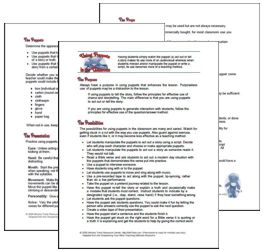
Using Puppets in the Classroom
Also check out the Using Puppets in the Classroom handout by Ministry Tools Resource Center. This three-page teacher training resource helps teachers think through various aspects of using puppets as a teaching method in the Bible classroom.

An Acrostic with Tips for Using Puppets

Please note that the following acrostic is not included in the above-mentioned handout though some of the tips are similar.

P – Purpose

Make sure the use of puppets enhances the lesson. Have a higher purpose than merely because students enjoy them. We teach for learning and growth, not for entertainment.

U – Usage

Learn the proper way to use a puppet (i.e., mouth movement, how to enter, realistic movement, etc.).

P – Props

While a stage, background scenery, and other props can be used, they aren’t always necessary. Sometimes less is more.

P – Practice

Get comfortable manipulating the puppet and maintaining a consistent voice and personality for it. Know the script well enough that you don’t have to keep looking at notes.

E – Engagement

Provide opportunity for students to interact when possible, such as having the puppet ask questions for students to answer.

T – Timing

Determine when using puppets best fits the lesson. Also consider how often to use puppets so their use doesn’t become less effective.

S – Simplicity

Make sure the puppets themselves and their planned usage is simple enough to get the message across. Especially consider age level developmental factors and interests of students. A complicated plot, too many puppets, or excessive props, can become more of a distraction to learning.

Share:

Teaching Methods: Explore the Possibilities

Share:

With so many different teaching methods, why do some Bible teachers use the same method over and over? Perhaps we get stuck in a rut using that with which we feel most comfortable. Maybe we don’t view ourselves as creative. Or, perhaps we don’t realize all the possibilities. And, if we do know of other methods, maybe we don’t know how to effectively use them.

Why We Need to Explore the Possibilities

Think about the students. What we’re comfortable with may not fit their needs, interests, and learning styles. Boredom can so easily set in when lessons lack variety. The same method used repeatedly can lose its effectiveness. Bible teaching isn’t just about the teacher.

Begin with a General Awareness of Different Teaching Methods and How to Choose Them

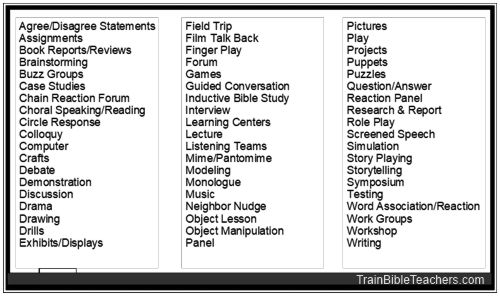
Start with a list of possible methods.

List of Teaching Methods Possibilities

The ten-page Tips for Choosing and Using Methods Worksheet by Ministry Tools Resource Center briefly defines each of those methods. It also walks you through group factors to consider in deciding which method fits your lesson and class.

Then Delve Deeper into the Various Methods

Take time to learn more about the different teaching methods. The Sharpening Your Bible Teaching Methods Resource by Ministry Tools Resource Center, gives help with the above list of 57 different methods, many of which have variations, increasing the possibilities. This 190-page resource runs each of the methods through the same group factors referenced in the above-mentioned worksheet, along with skills needed to effectively use each method. It also includes charts to help you see which methods work best according to group size, objective, age level, category (expressional, impressional, group interactive), and time required.

You can find even more help on methodology at: Teaching Methods – Teacher Training Resources

Share: