
Puppets can be an effective teaching method when their use meets certain conditions. Below you’ll find an acrostic of tips for using them in the Bible classroom.
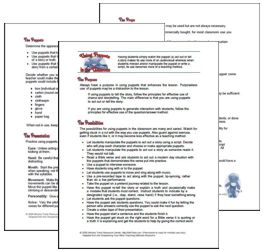
Also check out the Using Puppets in the Classroom handout by Ministry Tools Resource Center. This three-page teacher training resource helps teachers think through various aspects of using puppets as a teaching method in the Bible classroom.
An Acrostic with Tips for Using Puppets
Please note that the following acrostic is not included in the above-mentioned handout though some of the tips are similar.
P – Purpose
Make sure the use of puppets enhances the lesson. Have a higher purpose than merely because students enjoy them. We teach for learning and growth, not for entertainment.
U – Usage
Learn the proper way to use a puppet (i.e., mouth movement, how to enter, realistic movement, etc.).
P – Props
While a stage, background scenery, and other props can be used, they aren’t always necessary. Sometimes less is more.
P – Practice
Get comfortable manipulating the puppet and maintaining a consistent voice and personality for it. Know the script well enough that you don’t have to keep looking at notes.
E – Engagement
Provide opportunity for students to interact when possible, such as having the puppet ask questions for students to answer.
T – Timing
Determine when using puppets best fits the lesson. Also consider how often to use puppets so their use doesn’t become less effective.
S – Simplicity
Make sure the puppets themselves and their planned usage is simple enough to get the message across. Especially consider age level developmental factors and interests of students. A complicated plot, too many puppets, or excessive props, can become more of a distraction to learning.