Training for Teachers New to Teaching the Bible

Share:

All teachers, regardless of previous experience, benefit from strategic pre-service training. People new to teaching the Bible need specific training prior to placement into a teaching position.

What Teachers New to Teaching the Bible Should Know Before They Begin

Start with a basic understanding of the Bible and its message.
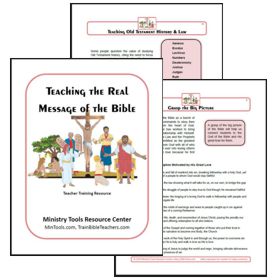
Teaching the Real Message of the BibleUnlike any other book, the Bible’s uniqueness suggests that even those who have taught in a traditional school setting gain at least a basic understanding of the Text they will teach. People don’t need an exhaustive knowledge of the Word before teaching but at least a solid big-picture understanding. Even veteran Bible teachers continue to learn and grow. These training resources can help those new to Bible teaching gain that big-picture perspective:

Move on to a basic understanding of the Bible teaching-learning process.

New teachers also need a grasp on the goals of the Bible teaching-learning process. It goes beyond the acquisition of knowledge to addressing the heart as well as behavior. Beginning with head knowledge, it culminates in “bearing fruit in every good work, growing in the knowledge of God” (Col. 1:9-11). Teachers need to know how to structure individual lessons to increase the potential of their students reaching that end goal. Here’s a resource to help:

New Teachers Will Also Benefit from Other Basics

Know age level characteristics.

God made people to learn certain ways at different stages of their development. Though curriculum usually accommodates the age level, teachers will face teaching moments off script before or after class, even during activities. New teachers therefore need a basic understanding of the age they’ll teach. Here are resources to help:

Know how to effectively use curriculum.

People new to Bible teaching need to understand the role of curriculum as a guide, with the Bible being the real Text. While lesson preparation will tie into the curriculum being used, we need to study God’s Word and not rely solely on the curriculum. We need to depend on God’s Spirit to make truth known. We mustn’t underestimate the role of prayer in both preparing and presenting the lesson. Training should therefore include specifics about the curriculum itself but also emphasize the role of the Holy Spirit and prayer. Check out these resources:

If teaching children or youth, new teachers would benefit from some discipline basics.

Even with all of the above understood and implemented by new teachers, disillusionment and discouragement can set in if students don’t cooperate or pay attention. So teaching doesn’t become more about “crowd control” than actual teaching, new teachers need at least a basic understanding of managing classroom discipline before beginning to teach. These training resources provide some of the basics. In time, training on classroom discipline can go deeper.

Other training topics like methodology, creativity, time management, and more, are important but but people new to teaching the Bible may get overwhelmed with too much too fast. Begin with the basics and then continue with in-service training to fill in the gaps.
Share:

Exceptions to Who Needs Bible Teacher Training?

Share:

We all would benefit from training to sharpen our Bible teaching skills. How much more this holds true for those new to teaching the Bible. Yet, some may claim they don’t need teacher training, that they’re the exceptions.

Those Who Have Never Taught the Bible Before But May Think They’re an Exception to Needing Teacher Training

Let’s think about two situations that may prompt this reaction to training.

1) Wouldn’t those who have been a Christian for a long time and know the Bible well, but have never taught it, be an exception to needing teacher training?

Since more goes into the teaching-learning process than transmitting what we know, even those who possess biblical knowledge and spiritual maturity, need training. They may know the content well, but do they know how to develop an introduction that grabs people’s attention before getting to the biblical content? Do they know how to present the content creatively with methods that engage students? And, do they know how to work in an application that helps people see how the content relates to their lives and what to do about it?

Knowing Scripture is just a part of Bible teaching. What about classroom dynamics, discipline issues or other problems that arise, age developmental considerations, and more?

2) Wouldn’t those who have taught in a public school, but not a Bible class, be an exception?

Even people who taught for years in the public school setting should be trained to teach the Bible. Here’s why:

  • The Bible is a unique Book, different from textbooks for teaching math, science, history, etc.
  • The aim of Bible teaching differs from that of teaching general education subjects.
  •  The source and model of creative teaching must be the Lord to make an eternal difference.

Teacher Training Resources to Help Prospective Teachers with These Backgrounds

Teacher Training Workbooks Covering Broad Topics
Teacher Training Workbooks – range from 50-100 pages

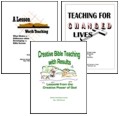
The following workbooks would be helpful to provide a broad overview for teaching the Bible:

A Lesson Worth Teaching
Teaching for Changed Lives
Creative Bible Teaching with Results

For help with specific topics, go to: Bible Teachers Training Resources

Share:

Develop an Effective Teacher Training Plan

Share:

Developing teacher training plans months in advance gives time to adequately prepare. Perhaps, however, you’re heading into a new church calendar year or are already in the midst of Bible classes. It’s never too late to reevaluate and strengthen what you’re doing to train Bible teachers. Start with a plan.

How to Develop an Effective Teacher Training Plan

The following acrostic provides basic elements that will enable you to develop a plan that encourages and equips your teachers to effectively teach God’s Word.

P – Pursue

Effective training doesn’t automatically happen. We need to pursue it, intentionally and actively putting time and effort into it. Throughout the process we must also wholeheartedly seek after God, remembering his promise that “If any of you lacks wisdom, you should ask God, who gives generously to all …” (James 1:5).

L – Listen

We need to listen to God for the direction He promises to those who trust Him (Prov. 3:5-6). We also need to listen to our teachers to “know the condition of your flocks” (Prov. 27:23). When we hear their concerns and what they perceive to be their needs, we’re better able to plan the topics and means of training that will be most helpful.

A – Assess

Having pursued God’s help and having listened to, observed, and perhaps surveyed teachers, we’re ready to determine priority needs for training. We’re in a better place to “consider how we may spur one another on” (Heb. 10:24) in their teaching.

N – Navigate

An effective teacher training plan finds the best route to meet priority needs in terms of subject matter and teachers’ preferred means of learning. We make it an ongoing journey, knowing that no one has arrived (Phil. 3:12). We must remain at the steering wheel, knowing there may be obstacles along the way. We mustn’t assume everything will just fall into place and that teachers will follow through.

Resource to Help in Planning

The Teacher Training Module of the Christian Education Files Download from Ministry Tools Resource Center can help you develop an effective training plan.

Christian Education Teacher Training ModuleFirst, a one page assessment will help you look at your approach to teacher training. Are you pursuing it in ways that will be most effective?
Second, a two page teacher training survey will help you listen to teachers and assess their priority needs.
Third, a twenty-nine page document will help you navigate through 23 different means of training teachers.

(Please Note: This module is part of the Christian Education Files Download but can be ordered separately.)

For more on having a teacher training plan read the following:

Share:

Teacher Training Over the Summer Months

Share:

Many churches discontinue Sunday School, small groups, children’s Bible clubs, and other Christian education programs over the summer. Should that also include teacher training? With people going on vacations and children home from school, you might reason, certainly people are too busy to attend training events. If you disband teacher training for the summer, how will teachers be ready to assume teaching responsibilities when classes resume?

Options for Teacher Training in the Summer

Before totally abandoning teacher training over the summer months, consider some alternatives that don’t require people to attend special meetings yet serve as a means of continued support and encouragement. The following resources from Ministry Tools Resource Center provide training that teachers can do on their own time, in their own setting, and at their own pace — a good formula for summer teacher training.

Bible Teachers Training Devotionals
These Teacher Training DEVOTIONALS range from 6 to 30 individual devotions. Even if teachers did only one a week, it would help to fortify their spirits as they head back into teaching.

Use Teacher Training Workbooks Over the Summer

Here are Teacher Training WORKBOOKS that range from 50-100 pages. This kind of training provides a more intensive study yet can be completed as people are able.

Bible Teachers Training Worksheets

And for even shorter options, here are Teacher Training WORKSHEETS that range from 1 to 10 pages. These are particularly good for tailoring training to specific needs of teachers.

If people are new to teaching, you might use the Teaching Ministry Manual. Only 29 pages, this resource could be used as a primer. Certainly that’s not asking too much over the summer months.

Share: