
A Teacher’s Love

Share:

Without Love a Teacher's Words Ring Empty
No matter how eloquent teachers speak, without love we miss the mark of truly effective teaching. A teacher’s love matters. It makes a difference.

If I speak in the tongues of men or of angels, but do not have love, I am only a resounding gong or a clanging cymbal. (1 Cor. 13:1)

When “Christ’s love compels us” (2 Cor. 5:14), we go beyond merely showing up to teach the lesson. We put the time into preparation to maximize true learning. We invest into the lives of our students both in and outside of the classroom because they matter.

Can we honestly say the following to our students?

“We loved you so much that we were delighted to share with you not only the gospel of God but our lives as well, because you had become so dear to us.” (1 Thess. 2:8)

Evidence of a Teacher’s Love

The following acrostic shows some of the ways teachers demonstrate love to their students, giving evidence of a teacher’s love:

L – Learn about Them as Individuals

Learn their names, interests, backgrounds, etc. Then use that information to engage them and to pray for and with them.

O – Offer an Oasis

Provide a safe place for people to express their doubts, fears, and failures … to be themselves. Build an environment where people can both laugh and cry together. Make it a place people want to be.

V – Value Them

Let people know they matter to you, that they’re important. Treat them like each person’s thoughts and contributions to class discussion matters.

E – Engage Them on a Personal Level

Ask questions about their lives. Truly listen when they talk. Make eye contact. If teaching children, get on their level. Speak with them outside of class.

What a difference it makes when Bible teachers truly love their students!

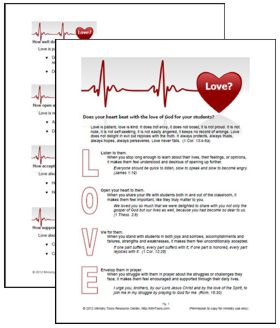
For another acrostic using the word LOVE, check out the Does your heart beat with the love of God? Worksheet.
Share:

Teachers Whose Hearts Beat with the Love of God

Share:

You may have come to this site for help with Bible teaching skills. That’s important, but so is a teacher’s heart, specifically one that beats with the love of God.

Why a Heart Beating with God’s Love is Essential

Without love what we do is empty, not as eternally impacting as we might hope.

If I speak in the tongues of men and of angels, but have not love, I am only a resounding gong or a clanging cymbal. (1 Cor. 13:1-3)

Students will appreciate good teaching but will long remember teachers whose hearts beat with God’s love. So, “over all these virtues put on love” (Col. 3:14).

How a Heart that Beats with the Love of God is Evidenced

Does Your Heart Beat with the Love of God?
The characteristics of love listed in 1 Corinthians 13 will be demonstrated in practical ways toward students when our hearts beat with His love. These traits will replace natural tendencies to react in self-protective or self-serving ways when confronted with trying moments in the life of a teacher. Check out the Does your heart beat with the love of God for your students? Worksheet that uses 1 Corinthians 13 to help you answer that question.

Love is patient, love is kind. It does not envy, it does not boast, it is not proud. It is not rude, it is not self-seeking, it is not easily angered, it keeps no record of wrongs. Love does not delight in evil but rejoices with the truth. It always protects, always trusts, always hopes, always perseveres. Love never fails. (1 Cor. 13:4-8a)

What It Takes to Acquire This Kind of Heart

Remember that we can only love “because He first loved us” (1 Jn. 4:19). So, our first step to acquiring this kind of heart is to “know and rely on the love God has for us” (1 Jn. 4:16).

To love as our Lord loves doesn’t come naturally. We need supernatural help to love our students, especially those who seem unlovable. Let’s yield all of who we are to His Spirit to work in and through us, knowing that “the fruit of the Spirit is love …” (Gal. 5:22).

Share:

Teacher Qualities Matter, Not Just Teaching Skills

Share:

God Looks at the Heart so Teacher Qualities Matter
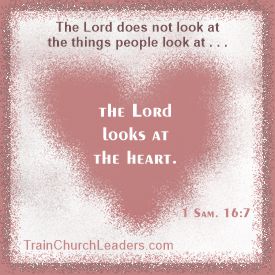
What Bible teachers do matters, so training to improve teaching skills is important. At the same time, we must remember that God puts more emphasis on the heart — “People look at the outward appearance, but the Lord looks at the heart.” (1 Sam. 16:7). That means that we too must be concerned about teacher qualities. Reflect on Scripture verses about the source of our words and actions:

The good man brings good things out of the good stored up in his heart, and the evil man brings evil things out of the evil stored up in his heart. For out of the overflow of his heart his mouth speaks. (Lk. 6:45)

Above all else, guard your heart, for it is the wellspring of life. (Prov. 4:23)

In God’s economy, “doing” grows out of “being” so heart qualities matter.

Why We Tend to Focus More on Teaching Skills Than Teacher Qualities

Focusing on what we “do” to teach effectively is relatively easy and measurable. We can therefore find a fair amount of training for skill development. Teacher qualities, on the other hand, are not easily acquired and are less quantifiable. Teacher training resources tend to yield less help in this area.

Teachers can outwardly mimic good teaching skills. Behavior reflective of the right qualities can also be copied. If, however, the heart remains unchanged, that behavior will not be authentic and will tend to diminish over time. Eventually what’s on the inside comes out (Lk. 6:45).

How to Be The Kind of Teacher Who Makes a Difference

Becoming who we should be from the inside out is a process, what Scripture refers to as sanctification. It begins with salvation but continues as we walk with God in the newness of life He provides. While heart transformation is a work of God, we can do some things to nurture that journey:

  • Ask the Holy Spirit to work “in” us as well as “through” us.
  • Seek prayer support to “be” the kind of teacher who makes a difference, not just to “do” that which makes us effective.
  • Look for role models with Christ-like qualities, not just good teaching skills.
  • Take advantage of biblically based devotionals geared to teachers that emphasize heart qualities. (i.e., Be-Attitudes for Teachers)
  • Find accountability and fellowship with leadership and among teaching staff for nurturing our walk with God.

More to Read:

Share:

Love is the Greatest

Share:

Believers are exhorted to love one another as Christ loves us (Jn. 15:12-13; Eph. 5:1-2). So, Bible teachers, ask yourself this question: How much of a priority do you place on loving your students?

Loving Our Students is a Priority Because Love is the Greatest

According to God’s Word, love should be a priority because …

Love is the greatest command.

“Love the Lord your God with all your heart and with all your soul and with all your mind.” This is the first and greatest commandment. And the second is like it: “Love your neighbor as yourself.” (Matt. 22:36-40)

Hence, what greater priority can we have than love for God which flows into loving others.?

Love is the greatest characteristic.

And now these three remain: faith, hope and love. But the greatest of these is love. (1 Cor. 13:13) … over all these virtues put on love. (Col. 3:14)

Teachers who truly care tend to be remembered the most as those who made a real impact in their students’ lives.

Loving as Christ Loves Us

Since Love is the Greatest, Does Your Heart Beat with His Love?Jesus didn’t just verbally express His love. He demonstrated it. We may not physically lay down our lives for others as He did (Jn. 15:13), but there are many other ways to demonstrate it. The love of Christ can be exemplified in practical ways as seen in the description of God’s love (agape) in 1 Corinthians 13. Use this resource to reflect on your love for students: Does your heart beat with the love of God? Worksheet

You may also be helped with resources listed at: Loving Students

Share: