
The application of a Bible lesson doesn’t always look the same for everyone. Teachers should therefore structure this part of the lesson so students can see how to personalize application of truth to their own lives.
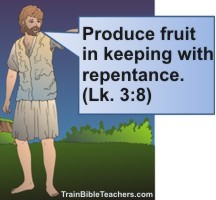
We find a good example of this in Luke 3:7-14 where John the Baptist was preaching a message of repentance for the forgiveness of sins. He admonished the crowd to “Produce fruit in keeping with repentance.” (Lk. 3:8)
The Broad Application Applies to Everyone
Two parts of John’s message applied to every person’s life.
1) Everyone needed to repent so their sins could be forgiven.
They all had a need to turn from their old ways to God, beginning with a change of mind, acknowledging that their ways were not God’s ways.
2) Everyone also needed to bear fruit that reflected their repentance.
If they truly repented in their hearts and minds, their behavior would change. They would not stay the same.
Bible Teachers: Always look for a broad application of the lesson that applies to all students. What kind of response should all students put into practice? It could be to repent or maybe to show love for God, or to love others, or to trust God, or to serve God, or to worship God, or to be a witness, or to share with others, etc. Because each person’s circumstances may vary, the specific outworking might differ from student to student. We therefore also need to personalize application specifically to their lives.
Personalize Application of Truth in Specific Ways
After John told the people to produce fruit in keeping with repentance, the crowd asked, “what should we do then?” (Lk. 3:10). The specific application was the same for many. He replied, “Anyone who has two shirts should share with the one who has none, and anyone who has food should do the same” (Lk. 3:11).
For some, however, he needed to personalize the application due to their occupations.
To the tax collectors he said, “Don’t collect any more than you are required to” (Lk. 3:13).
To the soldiers he said, “Don’t extort money and don’t accuse people falsely – be content with your pay” (Lk. 3:14).
Bible Teachers: Recognize that though the broad application of the lesson fits everyone, specific ways of carrying it out may vary due to a person’s background, occupation, or other circumstance. Since students face differing struggles, temptations, and opportunities, it stands to reason that the specific application does as well.
Use sharing as an example. Not all students struggle with sharing so what purpose does it serve to merely ask them to share? Perhaps a student who already shares does so begrudgingly. Wouldn’t it be better to for this person to deal with heart attitudes? Or perhaps a student shares only when convenient or comfortable. Wouldn’t it be better for that person to acknowledge the sacrificial aspect of sharing?
Guide students in looking at their lives to see implications of a given truth that specifically fits them. If they personalize application of truth, they’ll have a greater tendency to actually apply it to their lives.
More Help with Application: