FAQ about Creativity

Share:

FAQ about Creativity & Creative Bible Teaching

Few of us would doubt the benefits of creative Bible teaching. Yet, becoming more creative can be an issue for many teachers as reflected in frequently asked questions about creativity.

Why does creativity seem so hard for some teachers?

We all have the potential for being creative since we were made in the image of God (Gen. 1:26-27). Some will naturally be more creative due to personality, background, training, etc. Some will have to work harder at being creative. It might be more difficult for some because of one or a combination of the following reasons:

  • Conditioning: Along the way our sense of wonder and adventure may have been squelched by well-meaning parents and/or teachers who insisted on conformity. Or, we may have been stifled by a lack of good examples of creativity.
  • Comparisons: We might be so busy comparing ourselves to others who are more creative that we get to feeling insecure and defeated before even trying.
  • Comfort: We might resist taking risks or being challenged. Staying in the safety of our comfort zone feels better.
  • Custom: We might be in a rut, doing things the same way we’ve always done them, oblivious to the need to change.

So, that may lead you to ask, “What are some ways to become a more creative Bible teacher?”. An answer to that question can be found in the Bible Teacher’s Handbook of Frequently Asked Questions along with responding to a question about the purpose of creative Bible teaching. The handbook also asks questions about 48 other issues, with a total of 153 questions.

For More about Creativity, Go To: Teacher Training Resources for Creative Bible Teaching

Share:

Tweaking the Curriculum

Share:

When You Need to Adjust the CurriculumA previous post questioned the validity of always blaming curriculum when teaching doesn’t go well. Sometimes lessons could go better by simply making some adjustments — tweaking the curriculum.

What Tweaking the Curriculum Might Mean

Sometimes tweaking will simply take changing illustrations within the introduction or application to make it more relevant to your particular students but it could mean redoing the entire section.

Sometimes tweaking will involve using guiding questions to fill in the gaps, add to, or clarify what the curriculum provides to ensure your students understand based on their level of Bible literacy.

Sometimes tweaking will mean making adjustments to methodology but it could require looking at completely different Bible teaching methods based on the abilities or interests of your students.

On occasion it might be necessary to lay aside the entire lesson plan and write your own Bible lesson. However, in most cases, you should still use the same topic or key passage. One of the purposes of using curriculum is so over the course of time, people receive a well-rounded understanding of Scripture. The scope and sequence chart used by curriculum companies maps out that plan. This is particularly essential for children’s classes.

Questions to Help Determine if Tweaks are Needed

  • Does the introduction need to be tweaked to make it more relevant to your students’ interests?
  • Do methods or visuals need to be tweaked to make them more interesting to your students or to better fit your facilities or time schedule?
  • Do you need to add more depth or detail to the lesson because your students already know the truths being presented?
  • Do you need to bring it down to your students’ level by focusing in on only the general concepts being presented?
  • Does the application need to be tweaked to make it more relevant to your students’ life experiences?

If you skip or add activities be careful not to lose the flow of the lesson. Watch for transitions and bridge any gaps your adjustment may leave.

Teacher Training Resource: When You Need to Adjust the Curriculum Worksheet

Share:

Blame Curriculum If Teaching Not Going Well?

Share:

Blame Curriculum when Bible Teaching Not Going Well?Perhaps students seem disinterested. You could blame it on the curriculum — lessons must not be relevant.
Maybe students are frustrated. You could blame it on the curriculum — content must be too theoretical, not within your students’ ability to understand.

Or, students could be bored. You could blame it on the curriculum — methods and visuals must not be creative enough.

Perhaps students don’t seem to be growing. You could blame it on the curriculum — content must not be deep enough.

You might be quick to think the solution is changing to a different curriculum. But, could it be you just need to change the way you use the curriculum?

Should you change to a different curriculum?

The most glaring reason to switch to a new curriculum is if it is not doctrinally sound. Also, if it consistently appears to miss the mark developmentally or in the teaching-learning process, then it is time to consider using a different curriculum. Ideally questions about these issues should be asked when choosing curriculum not once it is in use. See: What to Look for in Choosing Curriculum

Is the problem really the curriculum or the way the curriculum is being used? Teachers must step back and consider a couple realities about any curriculum:

All curriculum will undoubtedly have its pluses and minuses. Remember, the Word of God is the inspired writing, not the curriculum. The Word of God is infallible, not the curriculum. Yet, you should be using curriculum that seems to line up with what the Bible teaches, employing sound hermeneutics (means of interpreting it).

Curriculum writers develop curriculum for the general church populace. They cannot tap into each unique setting. Consequently, the curriculum will not always fit your particular students, facilities, or time schedule. Some curriculum provides alternative ideas to better fit your situation. Yet, curriculum you use should at least be in the general age level needs and ability range of your students. For Help: Age Level Development Resources

Should you change the way you use your curriculum?

If you tend to prepare lessons by only reading through the teacher’s manual, then you need to change the way you use your curriculum. God’s Word is the real Teaching Manual. You need to view curriculum more as a tool. Also Read: Lesson Prep: Awareness Needed

If you tend to always use the curriculum exactly as it is written, then you need to change the way you use your curriculum. You sometimes need to tailor it to your situation or to your students’ needs and interests. Resource: When You Need to Adjust the Curriculum Worksheet

If you teach out of the teacher’s manual, reading word for word, then you need to change the way you use your curriculum. You are relying too much on the curriculum. It is not intended to be read verbatim but rather to be used as a guide. It’s hard to keep a pulse on what’s happening and make adjustments as needed when tethered to the manual.

Let’s be honest: Can we always blame the curriculum if the lesson isn’t going well? Sometimes we need training on how to effectively use curriculum.

Share:

Benefits of Creativity in the Classroom

Share:

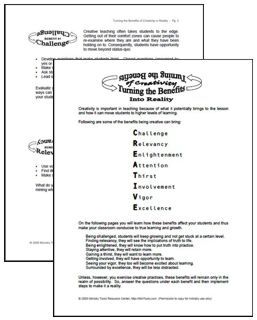
Benefits of Creativity Worksheet
Creativity matters in Bible teaching because of what it potentially brings to the lesson and how it can move students to higher levels of learning.

Check out the five-page Turning the Benefits of Creativity into Reality Worksheet based on the content of this post.

An Acrostic Listing the Benefits of Creativity

Challenge

Creative teaching often takes students to the edge. Getting out of their comfort zones can cause people to re-examine where they are and what they have been holding on to. Consequently, students have opportunity to move beyond status-quo.

Relevancy

Building creativity into a lesson causes the teacher to think about what will affect students in positive ways. Consequently, age-old truth is presented in ways that tap into people’s lives today.

Enlightenment

When we present the same content in a new or different way, people see it from a different perspective. Consequently, students often come to understand it better.

Attention

When students don’t know what to expect they will tend to remain more alert in the teaching-learning process. Consequently, the lesson will potentially not only grab their attention but maintain their attention.

Thirst

When students are interested and engaged in the lesson, they actually enjoy learning. Consequently, they want to keep coming back for more.

Involvement

One of the goals of a creative teacher is to increase participation by students. Consequently, students will tend to think more, feel more, do more, and hence, learn more.

Vigor

Because the teacher must work at the lesson more to make it creative, the teacher will have an even greater personal investment into the lesson. Consequently, the lesson will tend to be presented with more enthusiasm and energy.

Excellence

Creative teachers ask questions like, “How can I make this lesson better understood?” “How can I tap into the needs of my students?” “How can I engage my students in the process?” Consequently, as a result of constant evaluation, lessons are constantly improving.

Bible Teachers Training Resources with this acrostic on the Benefits of Creativity:

Share: