
Children love to play. Why, then, would we not incorporate playing into our Bible classes? Here’s the problem: We only have a short time so it seems we should make every moment count for teaching God’s Word.
3 Tips to Consider When Using Play as a Bible Teaching Method
To resolve the tension of play versus learning, keep this kind of focus:
1) Make play purposeful.
Get beyond using play just because children like to play. Understand that playing is how they learn. Incorporate play activities that reinforce the lesson. See play as more than a time filler. Make everything you do during the session lead toward the lesson’s goal.
2) See the bigger picture.
Realize that much more happens as children play, even beyond the lesson’s purpose. See the opportunities in it to address biblical issues like sharing (Heb. 13:16), kindness (Eph. 4:32), and other social skills that reflect God’s good, loving, and righteous character that we want to see in children.
3) Use guided conversation.
Don’t assume children are getting the point of the play activity. Talk with children, individually, as they play, about the truths they should be learning through it in a way that guides them toward God. For help, go to: Guided Conversation Worksheet
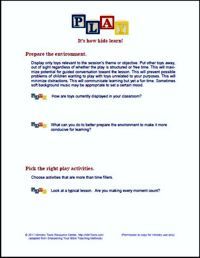
Learn to strategically incorporate play into lessons. Get more help in the Play: It’s How Kids Learn Worksheet. After each point in the worksheet, you’ll find questions asking you to examine your own teaching situation in light of that tip.