FAQ about the Bible Classroom Setup

Share:

FAQ about Classroom Setup

While much about the setup of your Bible classroom depends on your particular setting, age being taught, and your ability to make changes, it begins with determining the importance of classroom setup to the teaching-learning process.

A Question about the Importance of Classroom Setup:

How important is the classroom itself to the teaching-learning process?

While the classroom itself is not the most important element of Bible teaching, it can have an effect. A room filled with clutter or other distractions, poor lighting, either too hot or cold, etc. certainly can have a negative effect on learning. A comfortable, inviting environment can positively affect people’s impressions and openness to learning. Resource: Keys to Unlocking the Door for Good First Impressions

God, however, can work regardless of the setting so let’s not bemoan things over which we have little control. Think about the lessons Jonah learned in the belly of a stinky big fish. Think of how Jesus often taught out in nature but sometimes in a home or synagogue. While we should do our best to structure in accordance with how God made people, we must always remember that He can work anywhere.

Bible teachers might also ask these questions about the classroom:

  • How important is it to decorate the classroom to match the content being taught?
  • Is any particular classroom seating arrangement better than others?
  • What can be done if we have to share space with other classes?

You’ll find responses to these questions in the Bible Teacher’s Handbook of Frequently Asked Questions. That training resource looks at 48 other issues in Bible teaching, answering a total of 153 questions.

Also check the resources listed at: Classroom Set-Up – Effectively Use Facilities
Share:

Dealing with the Root Cause of Problem Behavior

Share:
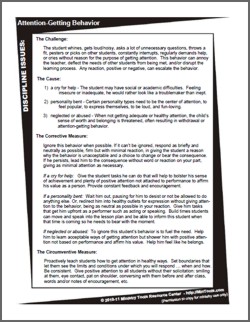
Discipline Issues Looks at Possible Root Causes
Click image to learn more about this Discipline Issues Resource.)


The best way for Sunday School teachers and children and youth workers in other Bible classes to deal with behavioral issues is to first determine the root cause of the problem.

The underlying cause of the same behavior in one child may not be the same for another. Do not assume but rather take time to consider what it might be.

Possible Root Causes of Behavior Problems:

  • Human Nature
  • Basic Needs
  • Developmental Characteristics
  • Home Background
  • Personality
  • Current Life Events

Once you have determined the root cause of behavior problem, you are ready to effectively discipline. Begin by acknowledging what is behind the symptoms and work at resolving the real issues.

The above content is included in the Teaching Ministry Manual along with a couple of questions under each item in the above list to assist in determining if that is the cause. The manual also includes a list of discipline tips and help for doing a short study on a biblical approach to discipline in contrast to discipline that does not follow after God’s ways. This manual also covers other topics relevant to Bible teaching.

Also check out: Discipline Issues: What to Do About Specific Challenges

This resource looks at 56 different behavioral challenges teachers could face. It describes the challenge and gives possible causes  with corrective measures that could help. And, it also provides tips for how you might circumvent, or prevent, the problem by the way you set up the classroom, teach, and interact with students.

Share:

10 Things Not to Say When Disciplining

Share:

The words a teacher uses when disciplining sends a message to children, and not always a good one. If you want to effectively handle classroom discipline, here are ten things not to say when you discipline.

“Because I said so.”

Problem: God is the ultimate authority, not you. Also, expecting blind obedience does little to help children understand issues. Always expect obedience  but have a valid reason for your expectations.

“You’re such a bad girl/boy.”

Problem: This is an attack on the person rather than the behavior. Yes, we are all depraved but we’re also created in the image of God. Treat children with dignity and respect. Don’t demean them.

“I’m sick and tired of you acting this way. I can’t take any more.”

Problem: For children, this kind of statement can be perceived as rejection. God doesn’t give up on us. He is patient, kind, loving, and merciful. Make discipline about helping the child, not about how you feel.

“When I was a boy/girl . . .”

Problem: Comparisons to the past take you out of the present moment, getting attention off the problem at hand. Besides, times have changed. Empathizing with a child can be helpful but often this approach is more about chiding than empathy.

“If you …. then I’ll give you …”

Problem: Bribing children to behave focuses on outward conformity rather than getting to the root problem and developing inner change and intrinsic motivation. You are focusing on short-term results rather than long term change.

“I’ve had enough.”

Problem: Students have been allowed to push you to your limit. When a teacher gets to this point, he/she often reacts out of anger or frustration rather than love and concern.

“If you don’t behave, I’m going to tell your parents.”

Problem: Too often this is an empty threat, a control tactic to intimidate the child into behaving. When parental involvement is needed, a mere statement of fact should be made and not a threat. A statement of fact will be followed through whereas a threat often is not.

“Now you’re going to be punished.”

Problem: The biblical word used for discipline indicates that disciplining is more like a tutorage program, not punishment. It looks ahead to what your children can become not simply what they did wrong.

“Don’t do this …. don’t do that …”

Problem: While rules are needed, they should be positively stated. The idea is to build up, not condemn. Surrounding children with a wall of no’s does little to motivate them.

“I know you can’t help it. It’s okay.”

Problem: Permissive teachers who let children slide on misbehavior fail to hold them accountable. It is not okay. They will not learn if you do not deal with it. Too often this kind of statement is more a matter of inconvenience or laziness on the part of the teacher or perhaps a misguided belief that he/she will be liked better with this kind of reaction. Failing to train a child by disciplining is not the loving thing to do.

Help for What to Say When Disciplining

The Right Words in Disciplining Grows out of Biblical PerspectiveTeachers will be more likely to use the right kinds of words in disciplining, ones that communicate the right message, when they have a good, biblical perspective on discipline. The Effectively Handling Classroom Discipline Workbook will lay that foundation. You can order that workbook for all your children’s Bible teachers and workers at a great savings. Click on the link to check it out in the Ministry Tools Resource Center store.

Also, share this article with children’s workers and Bible teachers by using the buttons below.
Share:

Helping Bible Teachers with “Problem Students”

Share:

Perhaps you are a Sunday School Superintendent, a Director of Christian Education, an age level coordinator, or other type of ministry leader responsible for assisting teachers. Suppose one of your teachers came to you about a “problem student.” Would you know how to help them?

To best help, you need to guard against quick fixes or merely applying band-aids. To do that you both need a good assessment of the problem so the right solution can be applied.

Questions to ask Bible Teachers with “Problem Students”:

1)  What is the problem?

Maybe the teacher has a student who monopolizes discussion or belittles other people for their comments, affecting group dynamic. Perhaps a student with special needs, like ADHD, constantly disrupts the lesson. Or, a student might have a pattern of misbehaving in certain ways that frustrates the teacher or is harmful to himself or others.

2)  For whom is it a problem?

This question helps you determine the severity of the problem or urgency of resolving it. Sometimes the problem could be due to a teacher’s unrealistic expectations or personality more than it is the students. Perhaps the problem mainly affects an individual student, keeping them from engaging in the lesson, learning, building friendships, etc. But, the issue could be affecting the whole class, disrupting learning, causing disunity, and the like.

If it is primarily a problem for the teacher or an individual student, it matters and must be worked on but it often can be dealt with over the course of time. Exceptions would be if the individual students is doing something harmful to himself. If it is a problem for the whole class, the problem must be immediately resolved.

3)  Why might the student be acting this way?

When teachers get to the core of what is wrong, they tend to actually help the student, not simply control behavior. They tend to disciple students toward Christ-like attitudes as well as conduct.

To determine the cause of a student’s problem, teachers might need to simply be more observant of what seems to trigger the problem. Or, the teacher might need to sit down and talk with the student and/or the student’s parents if a child. Sometimes researching possible causes could provide insight.

4)  How can you help the student?

Getting to the root cause of problems often leads to the best means of helping the student. Otherwise teachers might simply be taking actions that are counterproductive, making the situation worse, or just ineffective, having no impact. Sometimes the problem may appear to stop just to resurface if the teacher is not addressing the cause.

All students, regardless of their problems, need teachers to love them unconditionally with the love of Christ. They all need to be treated with dignity and respect. The student’s problem should not define their worth.

5)  How can we help you help the student?

This is where the Sunday School Superintendent, Director of Christian Education, or other ministry leaders extends support — counsel, feedback, prayer, resources, training.

Click on the links below for ideas to help your teachers with their “problem students”:

students who are monopolizers, belittlers, distractors, passive

students with specific behavior issues

students with special needs

students acting out their hurts


Share: