Are You Praying for Your Students?

Share:

We want our teaching to make a difference, so we pray that God helps us as we prepare and present the lesson. Bible teaching must be fueled by prayer. Are we also praying that God works in and through the lives of our students? Since prayer is “powerful and effective” (James 5:16), it only makes sense that we not only pray for our students but devote ourselves to praying for them (Col. 4:2).

Sample Prayers Teachers Can Pray for Their Students

The Apostle Paul constantly prayed for those to whom he ministered. Scripture records some of those prayers, the content of which would be good for Bible teachers to pray in regard to their students.
Praying Your Students Know God Better
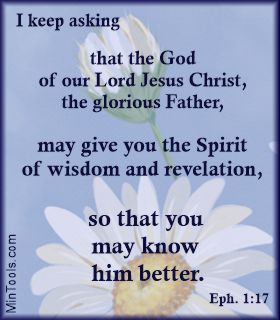
I keep asking that the God of our Lord Jesus Christ, the glorious Father, may give you the Spirit of wisdom and revelation, so that you may know him better. I pray that the eyes of your heart may be enlightened in order that you may know the hope to which he has called you, the riches of his glorious inheritance in his holy people, and his incomparably great power for us who believe. (Eph. 1:17-19)

I pray that out of his glorious riches he may strengthen you with power through his Spirit in your inner being, so that Christ may dwell in your hearts through faith. And I pray that you, being rooted and established in love, may have power, together with all the Lord’s holy people, to grasp how wide and long and high and deep is the love of Christ, and to know this love that surpasses knowledge – that you may be filled to the measure of all the fullness of God. Now to him who is able to do immeasurably more than all we ask or imagine, according to his power that is at work within us, to him be glory in the church and in Christ Jesus throughout all generations, for ever and ever! Amen. (Eph. 3:16-21)

And this is my prayer: that your love may abound more and more in knowledge and depth of insight, so that you may be able to discern what is best and may be pure and blameless for the day of Christ, filled with the fruit of righteousness that comes through Jesus Christ—to the glory and praise of God. (Phil. 1:9-11)

We continually ask God to fill you with the knowledge of his will through all the wisdom and understanding that the Spirit gives, so that you may live a life worthy of the Lord and please him in every way: bearing fruit in every good work, growing in the knowledge of God, being strengthened with all power according to his glorious might so that you may have great endurance and patience, and giving joyful thanks to the Father, who has qualified you to share in the inheritance of his holy people in the kingdom of light. (Col. 1:9-12)

With this in mind, we constantly pray for you, that our God may make you worthy of his calling, and that by his power he may bring to fruition your every desire for goodness and your every deed prompted by faith. We pray this so that the name of our Lord Jesus may be glorified in you, and you in him, according to the grace of our God and the Lord Jesus Christ. (2 Thess. 1:11-12)

Personalize these prayers, asking God to work in your particular students’ lives in these ways. Tailor the prayers to fit specific lesson aims.

Let Students Know You’re Praying for Them

Many of Paul’s epistles begin by letting people know of his prayers for them. Here are just a couple examples:

I have not stopped giving thanks for you, remembering you in my prayers. (Eph. 1:16)

We always thank God for all of you and continually mention you in our prayers. (1 Thess. 1:2)

Letting students know we’re praying for them can be a form of encouragement, especially when we tell them that our prayers include thanks to God for them. It’s also a means of putting the focus on God as the One who must work in their lives. We are just vessels He uses. God is the One who brings the growth (1 Cor. 3:7). He is the One on whom they must depend. So, let’s pray like we truly believe God is the Source.

Share:

Training Session: Audiovisuals Because of God

Share:

Since God’s Word thoroughly equips (2 Tim. 3:16-17), we must “in every way … make the teaching about God our Savior attractive” (Titus 2:10) to grab and keep people’s attention. While these passages don’t reference the use of audiovisuals in teaching, we do have a God who created us to learn through our senses and who Himself communicates audio-visually. For this reason, Bible teachers will benefit from a training session on audiovisuals.

Begin the Training Session with a Forced Choice Activity

Which would you prefer … attending a lecture with visual aids or without? If you would prefer attending a lecture without visual aids, go stand on the left side of the room. If you would prefer attending a lecture with visual aids, go stand on the right side of the room.

  • Why do you suppose everybody (or, almost everybody) chose the right side? (Undoubtedly all will go to the right side. If not, almost everyone will go to the right side. — Let several people respond before having them sit down.)

Key Reasons for Using Audiovisuals in Teaching

1) God made people to learn audio-visually.

(Write the point at the top of the left side of a white or chalk board. Below it, draw a circle and divide it similarly to the one below. Put the percentages in as you speak.)

How People Learn Audiovisually

God made people with five senses through which we interact with our environment and hence learn. Studies show that how we learn breaks down this way:

3% through our sense of smell
3% through our sense of taste
6% through our sense of touch
13% through our sense of hearing
75% through our sense of sight

Obviously using all of the senses, where possible, would yield the greatest impact on learning. But, at minimum, to teach the way God made people to learn, we must try to engage people not only through the sense of hearing but also visually … audio-visually.

2) God Himself communicates audio-visually.

(Write the point at the top on the right half of a white or chalk board. Discuss the following questions. List their responses to the first question below the point. You’ll find input in the article, God Communicates Audiovisually, that you can add to the discussion if not already stated by group members.)

  • What are some examples of God communicating audio-visually?
  • Why do you think God communicates using audiovisuals?
  • In what situations might God be against the use of visual aids? (Ex. 20:4-6)
  • What does all this infer for us as communicators of God’s Word?

Tips for Choosing & Using Audiovisuals

Since audiovisuals are so important in teaching, it’s vital we learn to use them well.

Tips for Using Audiovisuals Worksheet(For this part of the session, consider ordering the reproducible Tips for Choosing & Using Audiovisuals Worksheet which you can distribute to each teacher. The worksheet uses an acrostic with the word AUDIOVISUALS wherein each letter in the word gives a tip.

If you have sufficient time, you could go over the tips together and then have them break into pairs or triplets to work on the two exercises. If your group is small, you might want to do this together. To benefit from the exercises, it’s essential to first review the tips.)

Share:

Being Effective Bible Teachers Training Session

Share:

Teacher training often focuses on teaching skills. God, however, is most concerned about our hearts. Use this training session to make that point.

Introduction to a Training Session about Effective Bible Teaching

Raise your hand if you want to be an effective Bible teacher. That’s God’s desire for you as well. Look at 2 Timothy 2:15.

Do your best to present yourself to God as one approved, a worker who does not need to be ashamed and who correctly handles the word of truth.

Based on that verse, what teaching skills will it take to be effective in God’s eyes? What are other tasks that will make teaching more effective? (List responses on a white or chalk board, piece of poster board, or other means.)

While all these tasks from preparation to presentation and follow-up of the lesson help lead to effectiveness, God’s Word lets us know that God is most concerned with something else. (You can distribute the references to have different group members look up and read the verses from their Bibles, have the verses already typed out on sheets of paper for different individuals to read, or project verses for all to read together.)

1 Samuel 16:7
Proverbs 21:2
Matthew 12:34
Luke 6:45

Based on these verses, summarize God’s assessment of what matters most.  (Let someone give a summary. It should basically be that who we are, not just what we do matters most.)

Delving Deeper into Being Effective Bible Teachers

Now let’s make a list of qualities related to “being” that God deems important. (Using the following passages, make a list of qualities teachers need to “be” that will lead to greater effectiveness. Use the same means of making a list as you did earlier and display the list next to the first list.)

Galatians 5:22-23
Colossians 3:12-14
2 Peter 1:5-7

These qualities of “being” will help us “do” what we should do more effectively so let’s go deeper to personalize it to ourselves as teachers. (Give everybody a blank sheet of paper.)

Look at the list of what you must “do” to be effective. Which task do you seem to struggle with the most? (Have them write down what they personally struggle with the most at the top of the page.)

How might the “being” qualities help you to be more effective or more productive in accomplishing the task you just listed? (Give them a few moments to think about this question and write down their response. Then, ask at least a few of the teachers to share with everybody, allowing others to add into the assessment of how the qualities would help them. If time, you could break into groups of two or three for sharing. You could give this example: If struggling to take the time to adequately study and prepare, self-control, as seen in Galatians 5, will help us be more disciplined in setting aside the needed time and sticking with it, saying no to distractions, etc.)

Wrapping Up the Session about How Being Helps Us Do

We have seen how the qualities God looks for help us “do” the tasks we need to do as teachers. Here’s something we need to remember: God isn’t asking us to conjure up these qualities on our own.

Look back at Galatians 5:22-23. How does it begin the list of qualities? (Wait for a response.) — “But the fruit of the Spirit is …”

Now turn back to 2 Peter 1. The list of qualities began in verse five, but look at what verse 3 states: “His divine power has given us everything we need for life and godliness …”

To “be” the kind of teacher who makes a difference, God must be the One at work in our lives. We need to yield what we have on our papers to the Spirit to build these qualities in our lives. We need to pull on His power. Remember, Philippians 4:13. — “I can do all this through him who gives me strength.”

(Divide into pairs. Partners should swap papers, read what is on the paper, and then pray for that person. Suggest that they take their partner’s paper home and commit to praying for one another, perhaps even asking each other how it is going in upcoming weeks. If that seems too threatening for your group, you could simply ask teachers to write out a prayer for themselves on their paper. Suggest they commit to praying similarly over the next several weeks.)

Following up the Session with a Reminder to “Be” an Effective Teacher

Be-Attitudes for for Effective Bible TeachersFace it. We’re prone to forgetting. Think about how to remind teachers of these truths beyond the training session. It can be something simple like sporadically sending Scripture used in the session through text, e-mail, or social media.

At the end of the session, you could distribute the Be-Attitudes for Teachers Devotional Guide Download, suggesting teachers do at least one lesson a week.

Share:

Exceptions to Who Needs Bible Teacher Training?

Share:

We all would benefit from training to sharpen our Bible teaching skills. How much more this holds true for those new to teaching the Bible. Yet, some may claim they don’t need teacher training, that they’re the exceptions.

Those Who Have Never Taught the Bible Before But May Think They’re an Exception to Needing Teacher Training

Let’s think about two situations that may prompt this reaction to training.

1) Wouldn’t those who have been a Christian for a long time and know the Bible well, but have never taught it, be an exception to needing teacher training?

Since more goes into the teaching-learning process than transmitting what we know, even those who possess biblical knowledge and spiritual maturity, need training. They may know the content well, but do they know how to develop an introduction that grabs people’s attention before getting to the biblical content? Do they know how to present the content creatively with methods that engage students? And, do they know how to work in an application that helps people see how the content relates to their lives and what to do about it?

Knowing Scripture is just a part of Bible teaching. What about classroom dynamics, discipline issues or other problems that arise, age developmental considerations, and more?

2) Wouldn’t those who have taught in a public school, but not a Bible class, be an exception?

Even people who taught for years in the public school setting should be trained to teach the Bible. Here’s why:

  • The Bible is a unique Book, different from textbooks for teaching math, science, history, etc.
  • The aim of Bible teaching differs from that of teaching general education subjects.
  •  The source and model of creative teaching must be the Lord to make an eternal difference.

Teacher Training Resources to Help Prospective Teachers with These Backgrounds

Teacher Training Workbooks Covering Broad Topics
Teacher Training Workbooks – range from 50-100 pages

The following workbooks would be helpful to provide a broad overview for teaching the Bible:

A Lesson Worth Teaching
Teaching for Changed Lives
Creative Bible Teaching with Results

For help with specific topics, go to: Bible Teachers Training Resources

Share: